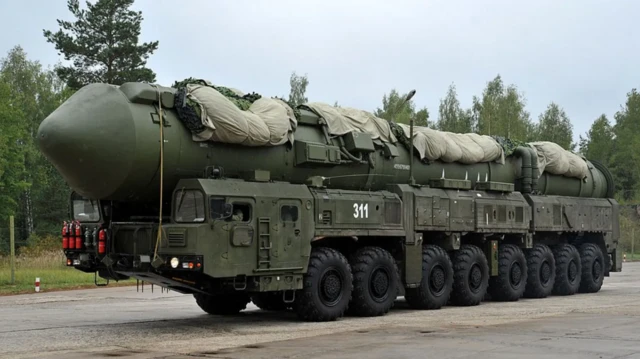
berbagiberkat.com – As tensions in Eastern Europe escalate amid the ongoing conflict in Ukraine, Russia is reportedly hastening the deployment of its advanced Oreshnik hypersonic ballistic missile system, a weapon capable of carrying nuclear warheads and described by Moscow as virtually impossible to intercept. Recent satellite imagery analysis and statements from Russian leaders indicate rapid preparations, including potential stationing in Belarus, positioning the missiles closer to NATO borders. This move comes as a strategic response to Western military support for Ukraine and anticipated U.S. deployments in Europe, raising concerns about a new arms race and heightened nuclear risks just weeks before the expiration of the last major U.S.-Russia arms control treaty.
The Oreshnik Missile: Capabilities and Claims
The Oreshnik (meaning “hazelnut tree” in Russian) is an intermediate-range ballistic missile (IRBM) with hypersonic speeds exceeding Mach 10 in its terminal phase. It features multiple independently targetable reentry vehicles (MIRVs) carrying up to six warheads, each potentially equipped with submunitions. Russian officials, including President Vladimir Putin, claim its maneuverability and velocity make it immune to existing missile defenses, with destructive power comparable to nuclear strikes even in conventional mode.
First used operationally in November 2024 against a Ukrainian facility in Dnipro, the missile has a reported range of up to 5,500 km, allowing strikes across much of Europe from Russian or Belarusian territory. It can be armed with conventional or nuclear payloads, underscoring its dual-use nature.
Recent Developments: Rush to Deployment
In mid-December 2025, Putin announced that the Oreshnik system would enter full combat duty by year’s end, with production ramped up and initial units delivered to troops. Belarusian President Alexander Lukashenko confirmed the arrival of systems in Belarus, stating they would be operational soon.
Satellite imagery from November 2025, analyzed by U.S. researchers, revealed construction at a former airbase near Krichev in eastern Belarus—features like secured rail points and camouflaged launch pads consistent with Oreshnik infrastructure. Experts assess a high likelihood of deployment there, extending Russia’s strike range deeper into Europe.
This acceleration aligns with Russia’s revised nuclear doctrine and responses to Ukraine’s use of Western long-range weapons, as well as planned U.S. hypersonic systems like Dark Eagle in Germany in 2026.
Strategic Implications and International Reactions
Analysts view the deployment as political signaling: deterring NATO escalation in Ukraine while reassuring ally Belarus. Placing nuclear-capable systems outside Russia for the first time since the Cold War sends a strong message, potentially shortening warning times for European capitals.
Western experts note no immediate military necessity beyond posture, but it heightens risks of miscalculation. The timing coincides with the impending end of the New START treaty, the last U.S.-Russia nuclear arms limit agreement.
Ukraine and NATO have expressed alarm, with calls for sanctions on involved Russian entities. Some see it as escalation amid diplomatic efforts involving incoming U.S. leadership.
Challenges to Russia’s Claims
While Russia touts Oreshnik as revolutionary, Western assessments suggest it’s derived from existing ICBM technology with MIRV capabilities long possessed by major powers. Interception remains difficult but not impossible with advanced systems like U.S. SM-3 or Israel’s Arrow 3. Conventional accuracy may limit non-nuclear utility, per experts.
Russia’s push for rapid deployment of the Oreshnik reflects a broader strategy to leverage hypersonic and nuclear threats amid stalemate in Ukraine. As systems potentially move to Belarus, Europe faces renewed security dilemmas, prompting debates on deterrence and arms control. This development underscores the fragile balance in global nuclear posture as 2025 closes.
About the Author